India’s rural employment system is set to change from 2026 with the introduction of the G RAM G Scheme. Many people—especially rural workers, farmers, students, and even employers—are confused about what this scheme is, why MGNREGA is being replaced, and whether the change is good or bad.
This article explains everything in simple language, compares G RAM G with MGNREGA, and also honestly discusses the concerns and risks that common people should know before forming an opinion.
What is the G RAM G Scheme 2026?
G RAM G stands for Viksit Bharat – Guarantee for Rozgar and Ajeevika Mission (Gramin). It is a new rural employment guarantee framework that will replace MGNREGA from 2026 onwards.
In simple words:
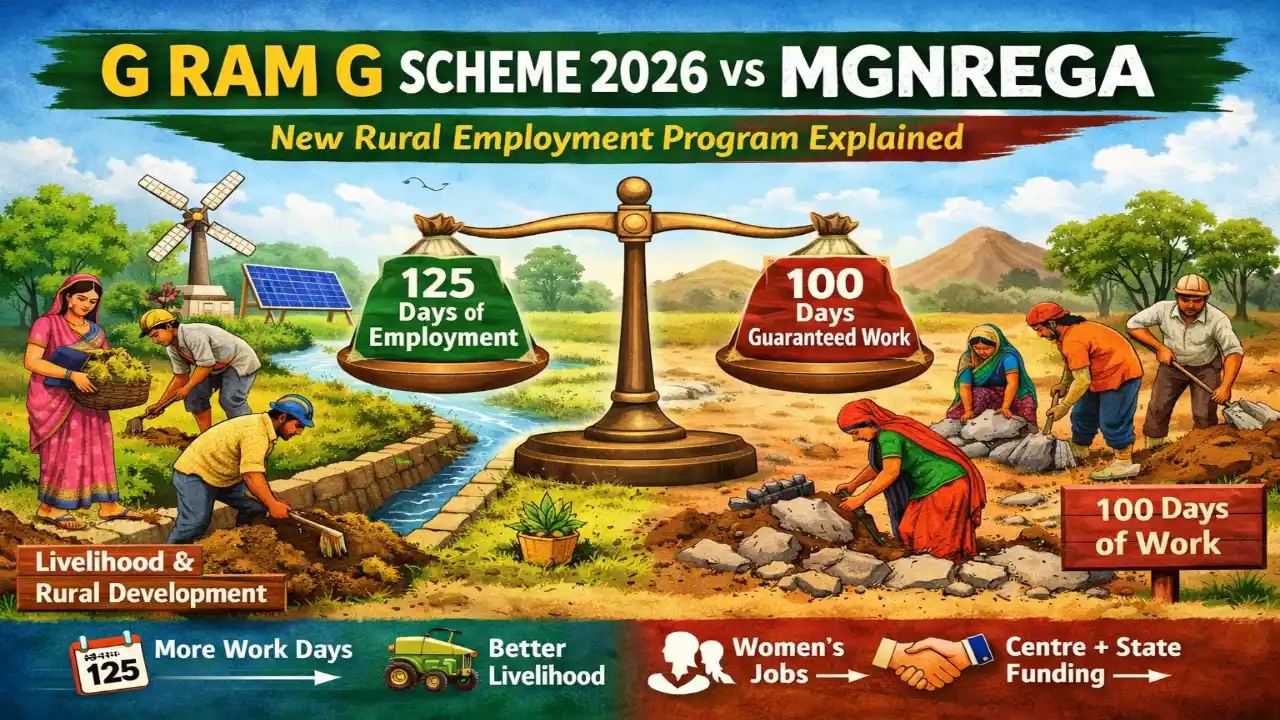
G RAM G is the government’s new version of MGNREGA, designed to provide more workdays and link employment with livelihood and rural development.
Why Was MGNREGA Replaced?
MGNREGA, enacted in 2005 and implemented from 2006 onwards, helped crores of rural families by guaranteeing wage employment. However, after nearly two decades, the government felt that:
- 100 days of work were not enough
- Rural workers need income-generating livelihood support, not only daily wage labour
- States should share more responsibility in funding and implementation
- Rural development should focus on long-term, productive assets
As a result, G RAM G Scheme was introduced as a restructured and expanded model.
Main Objectives of G RAM G Scheme
The G RAM G Scheme focuses on three key objectives:
- Guaranteed Rural Employment
Ensuring work for rural households willing to work. - Livelihood Security (Ajeevika)
Supporting income-generating and productive rural activities. - Sustainable Rural Development
Creating durable assets like irrigation facilities, water conservation systems, and climate-resilient infrastructure.
G RAM G vs MGNREGA: Simple Comparison
| Feature | MGNREGA | G RAM G Scheme |
| Year introduced | 2005 (implemented from 2006) | 2026 |
| Guaranteed work | 100 days per year | Up to 125 days per year |
| Focus | Wage employment | Employment + livelihood |
| Nature | Employment-focused Act | Employment & Ajeevika Mission |
| Women participation | Minimum 33% | Minimum 33% (continued) |
| Skill linkage | Limited | Encouraged |
| Funding | Mostly Central Govt | Centre + State sharing |
| Asset creation | Basic rural works | Durable & income-generating assets |
How Many Days of Work Will Be Provided?
- MGNREGA: Up to 100 days per household per year
- G RAM G: Up to 125 days per household per year
This increase can provide better income stability to rural families—if implemented properly.
Who Is Eligible Under G RAM G Scheme?
Eligibility remains largely the same as MGNREGA:
- Rural households
- Adult members willing to work
- Job card–based identification (new system may be introduced)
Existing MGNREGA workers are expected to be migrated to the new scheme, not removed.
What Type of Work Will Be Provided?
Under MGNREGA
- Earthwork and digging
- Road repair
- Pond and trench work
- Manual labour-focused activities
Under G RAM G
- Water conservation and irrigation projects
- Agricultural and rural infrastructure
- Climate-resilient development works
- Livelihood-linked and productivity-based activities
The idea is to create assets that generate long-term benefits, not just short-term wages.
Women and G RAM G Scheme
Women remain a key focus area.
- Minimum one-third participation continues
- Preference in certain livelihood-based works
- Support for rural women’s income stability
This ensures economic dignity and empowerment for women workers.
Funding Pattern – What Has Changed?
| Area | Central Government | State Government |
| Normal States | 60% | 40% |
| North-Eastern / Hilly States | 90% | 10% |
Earlier, MGNREGA was mostly Centre-funded, but now states share more responsibility.
Will Wages Change Under G RAM G?
- Wages are expected to be notified separately on a state-wise basis, similar to the existing MGNREGA wages framework
- Under MGNREGA, wage rates are notified independently and may differ from State Minimum Wages
- Provisions for timely wage payment are proposed to continue
- Digital tracking and monitoring systems are expected to be used to improve transparency
Workers are not expected to lose wage protection; however, actual outcomes will depend on effective implementation at the ground level.
Benefits of G RAM G Scheme 2026
- More guaranteed workdays
- Better focus on income generation
- Improved rural infrastructure
- Continued legal backing for employment
- Special focus on women’s participation
On paper, G RAM G looks like an improvement over MGNREGA.
Concerns and Challenges of G RAM G Scheme 2026
While the scheme promises progress, there are important concerns that people should be aware of.
1. Possible Weakening of “Right to Work”
Under MGNREGA, employment on demand and unemployment allowance provisions were clearly defined. With G RAM G framed as a Mission-based framework, accountability in providing work may weaken in practice.
2. Centre–State Funding Burden
Under the new scheme, states are required to share a significant portion of the total cost. Financially weaker states may limit work allocation or delay project approvals, affecting employment availability.
3. Shift Toward Productivity-Based Work
The increased focus on productivity and asset creation may pose challenges for elderly workers, women, and unskilled labourers, particularly if work expectations become performance-linked.
4. Wage Payment Delays May Continue
Although digital systems are intended to improve transparency, Aadhaar-based and technology-driven payment systems may still result in delays if technical issues persist.
5. Transition Problems for Existing Workers
The migration of existing MGNREGA job cards and work records to the new system may lead to temporary confusion, data mismatches, or delays in work and wage payments.
6. Reduced Local Transparency Risk
If social audits, Gram Sabha oversight, and local monitoring mechanisms are not strictly enforced, worker participation and transparency may decline.
7. Focus on Livelihood May Ignore Immediate Needs
While livelihood-based projects are important in the long term, many poor households depend on daily wages for immediate survival, making timely wage employment critical.
What Happens to Existing MGNREGA Job Card Holders?
- Existing workers will be shifted to the new system
- Benefits will not stop suddenly
- New formats or identification systems may be introduced
Workers should stay connected with Gram Panchayats and local officials during the transition.
Final Thoughts
The G RAM G Scheme 2026 is a major reform in India’s rural employment system. It has the potential to provide more work, better livelihoods, and stronger rural infrastructure.
However, its real success depends on:
- Honest implementation
- Adequate funding by states
- Strong transparency and monitoring
People must stay informed so that employment guarantees do not weaken in the name of reform.
FAQ
What is G RAM G Scheme 2026?
G RAM G Scheme 2026 is a new rural employment guarantee programme that replaces MGNREGA and focuses on employment along with livelihood creation.
What does G RAM G stand for?
G RAM G stands for Viksit Bharat – Guarantee for Rozgar and Ajeevika Mission (Gramin).
Is MGNREGA stopped from 2026?
MGNREGA is being replaced by G RAM G from 2026. Existing workers will be transitioned to the new scheme.
How many days of employment are guaranteed under G RAM G?
The scheme provides up to 125 days of employment per rural household per year, higher than MGNREGA’s 100 days.
Who is eligible for G RAM G Scheme?
Any rural household with adult members willing to work is eligible. Existing MGNREGA job card holders will be included.
What kind of work is provided under G RAM G?
Work includes rural infrastructure, water conservation, agriculture-related projects, climate-resilient works, and livelihood-linked activities.
Will women benefit under G RAM G Scheme?
Yes. At least one-third of employment opportunities are reserved for women, similar to MGNREGA.
What are the main disadvantages of G RAM G Scheme?
Concerns include possible weakening of the right to work, funding pressure on states, wage delays, transition issues, and reduced access for unskilled workers.
Will wages be reduced under G RAM G?
No. Wages are expected to remain linked to state-wise minimum wages, but timely payment remains a concern.
Is G RAM G better than MGNREGA?
No. Wages are not expected to be reduced, but the final wage rates will depend on state-wise notifications and implementation, and timely payment will remain an important factor.
Explore More :