
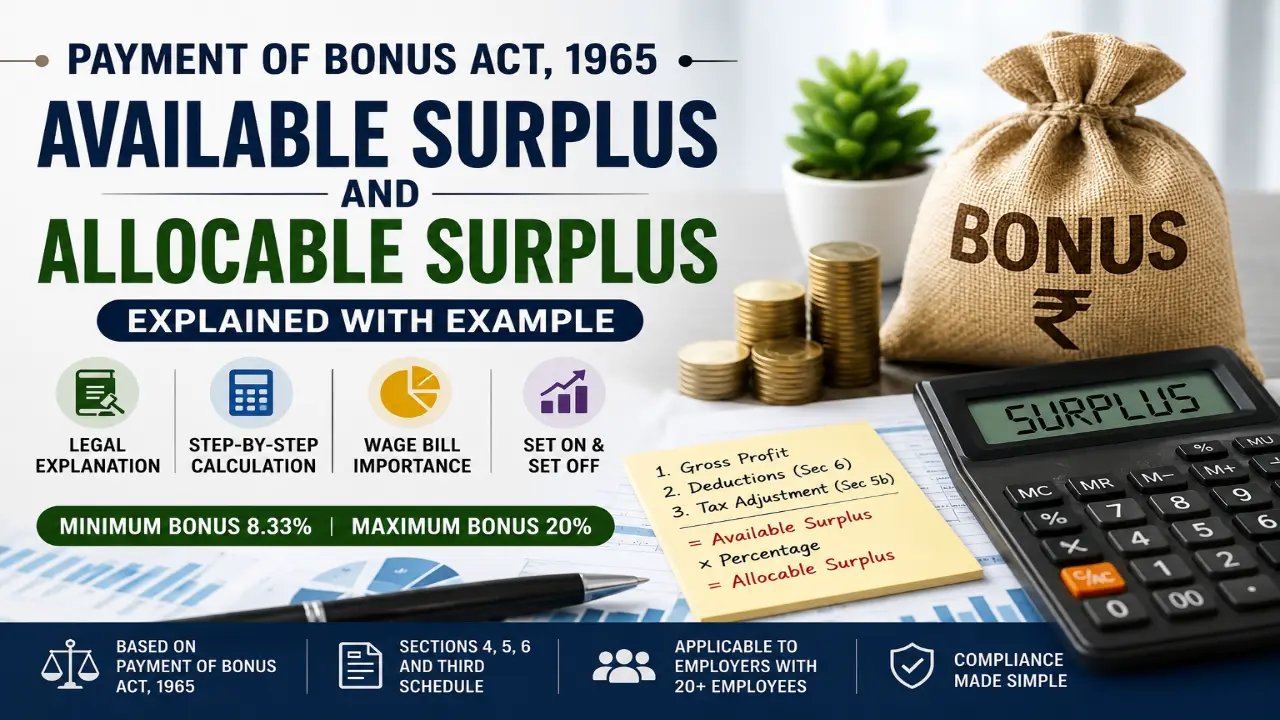
Every year, around Diwali or financial year-end, employees ask the same question: “How is my bonus decided?” And most HR professionals give a vague answer like “it depends on company profit”—because very few actually understand the two terms that legally decide the bonus amount: Available Surplus and Allocable Surplus.
These two terms come straight from the Payment of Bonus Act, 1965, and they are not optional corporate jargon—they are the exact numbers your company’s chartered accountant uses to calculate how much statutory bonus can legally be paid.
In this article, we break both terms down in plain language, show you the real statutory formula, walk through a worked example, explain the role of the Wage Bill, and cover what happens when profit is too high or too low (Set On and Set Off).
By the end, you will be able to explain this clearly to your leadership and team without opening a law book.
Why This Topic Matters
The Payment of Bonus Act, 1965 applies to every factory and every establishment employing 20 or more persons (or 10 or more in states with specific statutory notifications), making statutory bonus a legal entitlement rather than a discretionary gift.
The Act does not allow employers to “pay whatever bonus they feel like.” It mandates a structured calculation framework that hinges entirely on two metrics:
- Available Surplus: How much money is actually left over to consider for bonus, after the law allows the company to first deduct certain costs. It is the gross profits of an establishment for a year after deducting certain specified sums.
- Allocable Surplus: How much of that leftover amount the law says must actually be shared with employees as bonus. It is a percentage of the available surplus that is allocated for bonus payments.
Get these two figures right, and the applicable bonus percentage (between the statutory minimum of 8.33% and statutory maximum of 20%) calculates itself.
Step 1: What is Gross Profit? (The Starting Point)
Before computing Available Surplus, you need the base figure: Gross Profit.
Gross Profit is computed in accordance with Section 4 of the Act:
- First Schedule: Used if the employer is a Banking Company.
- Second Schedule: Used for all other establishments and corporate entities.
Think of Gross Profit as the total gross operational surplus before any statutory bonus adjustments, capital returns, or reserve deductions are applied.
Step 2: What is Available Surplus? (Section 5)
Available Surplus is Gross Profit minus certain specific prior charges allowed under Section 6, plus a statutory tax adjustment under Section 5(b).
In simple terms: before employees receive their bonus share, the law permits the business to first set aside money for taxes, wear-and-tear depreciation, and legitimate returns on capital/reserves. Whatever remains is the Available Surplus—the real pool of money from which statutory bonus is derived.
The Deductions Allowed Under Section 6
Only the following statutory deductions (prior charges) may be subtracted from Gross Profit:
- Depreciation: The depreciation allowable under Section 32 of the Income Tax Act, 1961 (or applicable agricultural income tax laws).
- Development Rebate / Investment Allowance: Any development rebate, investment allowance, or development allowance the employer is entitled to claim under the Income Tax Act.
- Direct Taxes: The income tax and direct taxes the employer is liable to pay for that accounting year on income/profits (calculated per Section 7 of the Act).
- Sums Specified in the Third Schedule: Statutory allowances for capital and reserves, including:
- A fixed percentage return on paid-up equity share capital (typically 8.5% for domestic companies).
- A fixed percentage return on reserves shown in the balance sheet at the start of the year (typically 6%).
- Contractual dividend returns on preference shares.
Common Misconception to Avoid: A lot of online articles describe point 4 loosely as “any amount the employer chooses to deduct.” That is incorrect. An employer cannot invent arbitrary internal deductions. Only items expressly listed under the Third Schedule of the Act are legally permissible.
The Tax Adjustment (Section 5(b))
A critical part of the formula under Section 5(b) that is often overlooked in online summaries:
Tax Adjustment = Direct Tax on Prior Year GP – Direct Tax on (Prior Year GP – Prior Year Bonus Paid)
Why does this adjustment exist? Because bonus paid to employees is a tax-deductible business expense. This adjustment ensures that the tax saving realised by the company from paying bonus in the prior year is added back so it does not artificially depress the surplus pool available for employees in the current accounting year.
Available Surplus Formula
Available Surplus = (Gross Profit – Depreciation – Tax Allowances – Direct Taxes – Third Schedule Sums) + Tax Adjustment (Sec 5(b))
Step 3: What is Allocable Surplus? (Section 2(4))
Once the Available Surplus is determined, how much of it must legally be distributed as bonus? That portion is the Allocable Surplus, defined by statute as a fixed ratio:
| Type of Employer / Establishment | Allocable Surplus Percentage |
| Banking Companies | 60% of Available Surplus |
| All Other Companies — including foreign companies operating in India | 67% of Available Surplus |
This is a mandatory statutory allocation. The Allocable Surplus represents the exact monetary pool legally earmarked for eligible employee bonus payouts for that accounting year.
FORM A – Computation Of The Allocable Surplus
Worked Calculation Example
Let us take XYZ Pvt. Ltd. (a non-banking corporate establishment) computing its bonus obligations:
| Step / Component | Amount (₹) |
| Gross Profit (computed as per Second Schedule) | ₹ 50,00,000 |
| Less: Statutory Depreciation (Sec 32, Income Tax Act) | − ₹8,00,000 |
| Less: Direct Taxes Payable for the accounting year | − ₹6,00,000 |
| Less: Capital & Reserve Deductions (Third Schedule) | − ₹1,00,000 |
| Subtotal after Section 6 Deductions | ₹ 35,00,000 |
| Add: Section 5(b) Tax Adjustment | ₹ 50,000 |
| Available Surplus | ₹ 35,50,000 |
| Allocable Surplus (67% for non-banking company) | ₹ 23,78,500 |
(Note: If the company had claimable development rebates or investment allowances, they would be deducted under Section 6 prior to arriving at the subtotal.)
What Happens Next?
The sum of ₹23,78,500 is the statutory pool for the year. The HR and payroll team distributes this pool among eligible employees, subject to statutory wage limits.
Understanding the “Wage Bill” (The Base for 8.33% and 20%)
Before you can determine whether your Allocable Surplus is enough to pay the minimum or maximum bonus, you must calculate the establishment’s Total Eligible Wage Bill.
What is the Wage Bill?
The Wage Bill under the Act is not the gross total salary of every employee in the company. It is the aggregate of eligible monthly wages (Basic + Dearness Allowance) of all bonus-eligible employees, adjusted for statutory calculation caps.
How the Wage Bill is Calculated:
- Filter by Eligibility (Section 2(13)): Only employees earning a Basic + DA up to ₹21,000 per month who have completed at least 30 working days in the accounting year qualify.
- Apply the Calculation Ceiling (Section 12): For any eligible employee earning between ₹7,000 and ₹21,000 per month, their bonus calculation base is capped at ₹7,000 per month (or the applicable state minimum wage for scheduled employment, whichever is higher).
- Aggregate the Annual Total: Sum up the capped monthly calculation wages across 12 months for all eligible employees.
Set On and Set Off: Managing Multi-Year Fluctuations (Section 15)
Business earnings fluctuate across economic cycles, but employees require income predictability. Section 15 of the Act resolves this through Set On and Set Off—operating as a statutory 4-year rolling reserve mechanism.
Bonus (8.33%)
(8.33% – 20%)
(20%)
The Two Core Principles
- Set On (Surplus Reserve): When Allocable Surplus exceeds the maximum bonus obligation (20% of the total eligible wage bill), the employer pays the 20% cap. The excess surplus is carried forward as a reserve called Set On (capped at 20% of that year’s wage bill) to absorb shortfalls in future years.
- Set Off (Shortfall Accounting): When Allocable Surplus is insufficient to meet the mandatory minimum bonus (8.33% of the total eligible wage bill)—or in case of net financial loss—the employer must still pay the full 8.33% minimum bonus in cash. The resulting deficit is carried forward as Set Off to be recovered against surpluses in future profitable years.
5-Year Worked Example (Form B Mechanism)
To illustrate how Set-On and Set-Off interact over time, assume an establishment with a fixed annual eligible wage bill where:
- Minimum Bonus (8.33%): Fixed at ₹80,000
- Maximum Bonus (20.00%): Fixed at ₹2,00,000
- Maximum Set-On per year: Capped at ₹2,00,000
| Year | Allocable Surplus | What Happens in Computation | Bonus Actually Paid | Carried Forward Balance (Form B) |
| Year 1 | ₹3,00,000 | ₹1,00,000 surplus above maximum cap | ₹2,00,000 (20%) | Set On: ₹1,00,000 |
| Year 2 | ₹1,50,000 | Short ₹50,000 of max; absorbed from Year 1 Set On | ₹2,00,000 (20%) | Set On Remaining: ₹50,000 |
| Year 3 | ₹40,000 | Short ₹40,000 of min; absorbed from Year 1 Set On | ₹80,000 (8.33%) | Set On Remaining: ₹10,000 |
| Year 4 | ₹0 (Loss) | Short ₹80,000 of min; ₹10,000 Set On used, ₹70,000 deficit | ₹80,000 (8.33%) | Set Off Created: ₹70,000 |
| Year 5 | ₹3,50,000 | Surplus ₹1,50,000 above max; clears ₹70,000 Set Off first | ₹2,00,000 (20%) | Set On Created: ₹80,000 (Year 4 Set Off fully cleared) |
FORM B – Set-On And Set-Off Of Allocable Surplus
Key Legal Rules Governing Set On / Set Off
- Non-Negotiable Minimum Payout: Even during loss years (such as Year 4), employees receive their full 8.33% minimum statutory bonus. Set Off is an accounting carryover, not a deduction from employee payouts.
- 4-Year Statutory Horizon: Any Set On or Set Off entry can only be carried forward for up to 4 consecutive accounting years following the year it arose. Unutilized balances lapse after the 4th year.
- First-In, First-Out (FIFO) Rule (Section 15(4)): Carried-forward amounts from earlier accounting years must be set off or utilised before adjusting balances from later years.
Quick Comparison: Available Surplus vs. Allocable Surplus
| Parameter | Available Surplus | Allocable Surplus |
| Core Definition | Operational gross profit remaining after statutory deductions | The statutory percentage of Available Surplus dedicated to bonus |
| Governing Section | Section 5 (read with Sections 6 & 7) | Section 2(4) |
| Base Formula | Gross Profit−Prior Charges+Sec 5(b) Adjustment | 60% (Banking Companies) or 67% (All Other Companies) of Available Surplus |
| Discretion | Arrived at via statutory formula | Fixed percentage determined strictly by law |
| Role in Compliance | Foundation for total surplus computation | Basis for final bonus distribution & Form A filing |
Key Takeaways for HR & Payroll Teams
Available Surplus and Allocable Surplus are the mathematical backbone of bonus administration under Indian labour law:
- Available Surplus is the net operational pool calculated strictly by subtracting Section 6 prior charges from Gross Profit and factoring in the Section 5(b) tax adjustment.
- Allocable Surplus is the non-negotiable 67% (or 60% for banking companies) share of that pool legally allocated for bonus.
- The Wage Bill determines the monetary floors (8.33%) and ceilings (20%) for actual disbursements.
- Maintaining updated Form A and Form B registers ensures the establishment remains fully compliant with the 4-year Set-On and Set-Off rules during statutory labour inspections.
Frequently Asked Questions (FAQs)
1. Is Allocable Surplus the exact amount disbursed to employees?
Not necessarily. Allocable Surplus is the total pool available for bonus. The actual disbursement depends on whether the total required bonus falls within the statutory bracket (8.33% to 20%) and how prior-year Set-On or Set-Off balances in Form B are applied.
2. Can an employer deduct discretionary reserves before calculating Available Surplus?
No. Deductions from Gross Profit are restricted strictly to those specified under Section 6 and the Third Schedule (depreciation under Section 32 ITA, direct taxes under Section 7, development/investment allowances, and prescribed capital/reserve returns). Discretionary internal reserves cannot be deducted.
3. Must a company pay a bonus if it registers a net loss?
Yes. Under Section 10, payment of the minimum bonus (8.33% of eligible salary or ₹100, whichever is higher) is a statutory obligation irrespective of whether the establishment has an available surplus or incurs a net operational loss. The deficit is recorded as Set Off under Section 15.
4. Why do banking companies have a 60% allocable surplus instead of 67%?
The 67% rate under Section 2(4) applies to any non-banking company that hasn’t made arrangements to declare and pay dividends within India under Section 194 of the Income Tax Act — a condition that covers virtually every ordinary company today, including foreign companies operating in India. Banking companies fall outside that clause by default, landing them at 60%. This lines up with the Third Schedule too: banks get their own, lower reserve-return percentages (7.5% on paid-up capital, 5% on reserves) versus 8.5%/6% for other companies, reflecting RBI reserve requirements banks already operate under.
5. What statutory registers must employers maintain?
Under the Payment of Bonus Rules, 1975, employers must maintain:
Form A: Computation of the Allocable Surplus (Rule 4(a))
Form B: Set-On and Set-Off of Allocable Surplus (Rule 4(b))
Form C: Register of Bonus Paid to Employees (Rule 4(c))
Form D: Annual Return of Bonus Paid submitted to the Inspector (Rule 5
Find More Posts :